
The Five Levels of Warehouse Complexity
Each company in this dataset was scored against the Warehouse Complexity Index, derived from Gartner’s enterprise warehouse complexity framework. Table 2 shows the distribution by complexity level. This sample largely contains companies operating at levels L1 through L4, with nearly half operating at Level 2.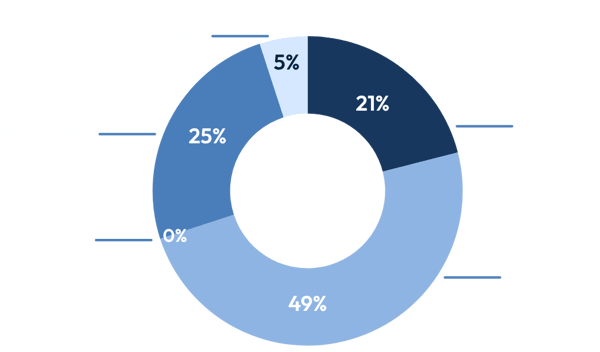
>
| Level | Complexity | % of Sample |
|---|---|---|
| L1 Basic | Single-site operations with limited channels and minimal tracking or regulatory requirements. | 21% |
| L2 Standard | Operations with multiple locations or fulfillment channels, plus basic bin, lot, or serial-tracking requirements. | 49% |
| L3 Moderate | Multi-site or multi-channel operations with more advanced traceability, serialization, regulatory, or integration requirements. | 25% |
| L4 Complex | Multi-subsidiary, global, highly specialized, or complex omnichannel operations. | 5% |
| L5 Highly Automated | Operations requiring orchestration of advanced automation, robotics, conveyors, sorters, or goods-to-person workflows. | 0% |
Table 2a. Warehouse Complexity Distribution by Sample


 The SMB Warehouse Operations Gap
The Five Levels of Warehouse Complexity
Hidden Complexity & Pain Dimensions
The Four Warehouse Operator Profiles Defined by What's Breaking
Profile 1: Analog Operator
Profile 2: Throughput Ceiling
Profile 3: Regulated Operator
Profile 4: Full System Breakdown
Why Warehouse Management Systems Fail
Download the PDF